
A recent headline caught my attention:
"India's Defence Sector Faces Execution Challenge as Order Backlogs Grow"
While the discussion is focused on defence manufacturing, the issue is much larger.
The same execution challenges exist across:
- Infrastructure Projects
- Railways
- Airports
- Buildings
- Industrial Facilities
- Urban Development Projects
The problem is rarely funding.
The problem is execution.
And execution is fundamentally a Project Management issue.
The Real Issue: Projects Are Individual-Centric
Many organizations believe they have project management systems.
In reality, they have project managers.
There is a significant difference.
A project management system should continue functioning regardless of who occupies the role.
Unfortunately, in many organizations:
- Planning depends on one planner.
- Monitoring depends on one project manager.
- Reporting depends on one individual.
- Follow-ups depend on personal effort.
As long as that individual remains active and engaged, project performance appears strong.
The moment attention shifts elsewhere, performance starts deteriorating.
This Is Not a Process-Driven Organization. It Is a Person-Driven Organization.
And person-driven systems rarely scale successfully.
The Missing Standard Operating System
Successful organizations build execution around:
- ✔ Standard Operating Procedures (SOPs)
- ✔ Weekly Monitoring Systems
- ✔ Defined Reporting Structures
- ✔ Accountability Mechanisms
- ✔ Escalation Processes
- ✔ Decision-Making Frameworks
When these systems exist, projects continue moving even when individuals change.
Without these systems, projects become reactive rather than proactive.
Projects Succeed Through Systems, Not Heroics.
The Danger of Over-Monitoring
Interestingly, poor execution is not always caused by lack of monitoring.
Sometimes it is caused by excessive monitoring.
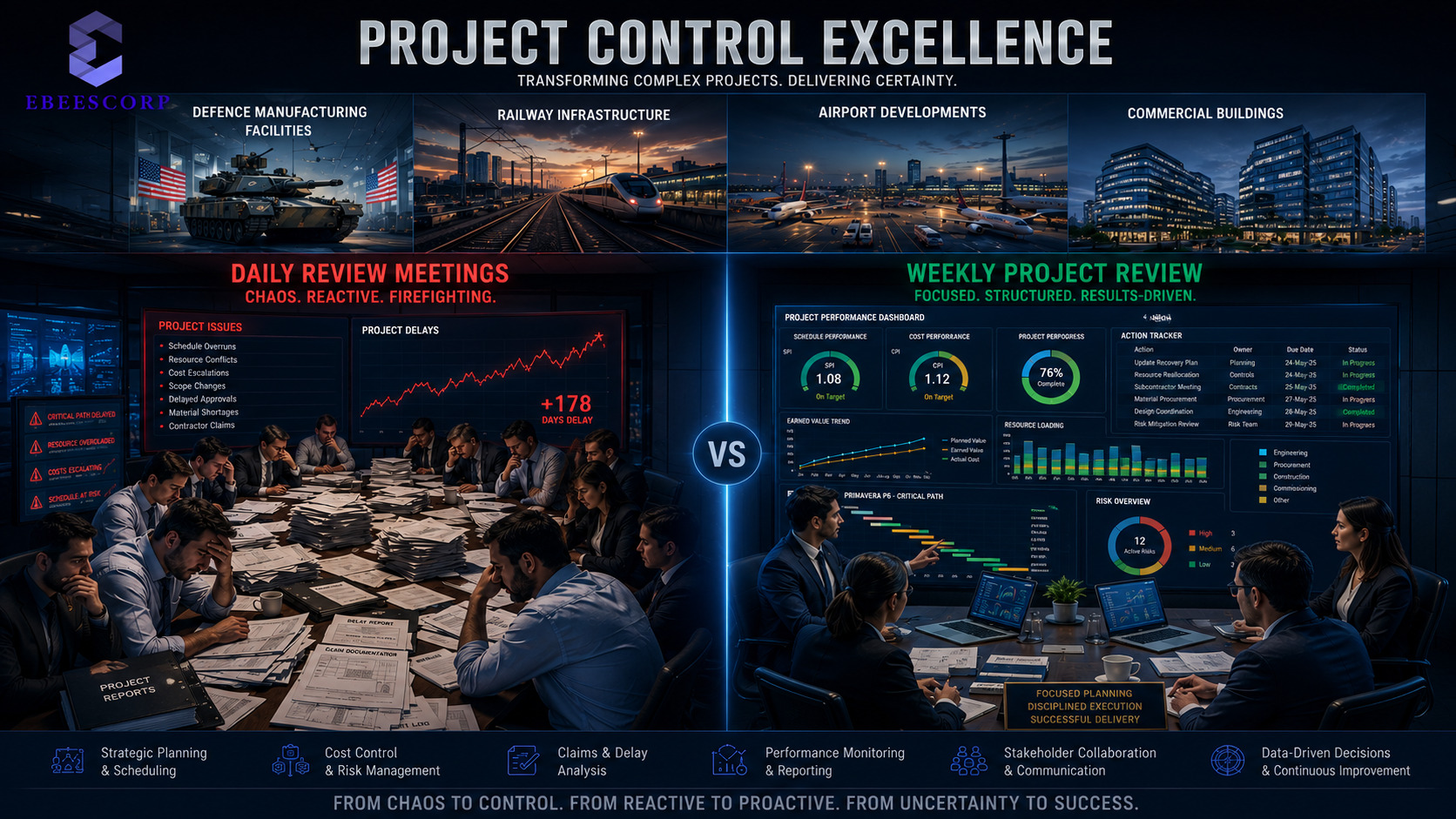
In several projects, review meetings are conducted every day.
The intention is good.
The outcome is often counterproductive.
A project team spends significant time:
- Preparing reports
- Explaining minor deviations
- Attending meetings
- Responding to queries
Instead of actually executing work.
Progress requires time.
- Concrete does not cure overnight.
- Procurement does not happen in a day.
- Engineering approvals take time.
Execution needs breathing room.
Why Weekly Reviews Work Best
In our experience across multiple infrastructure, railway, airport, industrial and building projects, the most effective review cycle is:
Weekly Monitoring
Weekly reviews provide enough time for:
- Meaningful progress
- Measurable outcomes
- Resolution of action items
- Identification of emerging risks
Most importantly, weekly reviews create accountability.
Every stakeholder knows:
- What was promised
- What was achieved
- What remains pending
- Who is responsible
This creates a rhythm of execution.
Not panic.
Not firefighting.
Execution.
Monitoring Is Not Micromanagement
One of the biggest misconceptions in project management is that more meetings equal better control.
They do not.
Effective project control requires:
- Timely information
- Meaningful analysis
- Clear accountability
- Decisive action
A review meeting should be a decision-making forum.
Not a status-reading exercise.
Project Control Is About Decisions, Not Discussions.
The Future of Indian Project Execution
India is entering a phase of unprecedented infrastructure growth.
Whether in:
- Defence Manufacturing
- High-Speed Rail
- Metro Projects
- Airports
- Industrial Corridors
- Smart Cities
The next challenge is not project sanction.
The next challenge is execution.
Organizations that build strong project control systems will consistently outperform those that rely on individuals.
Because projects do not succeed through effort alone.
They succeed through systems.
And systems thrive on consistency, accountability, and structured monitoring.
The Weekly Review Meeting May Seem Like a Small Thing. But In Many Organizations, It Is the Missing Link Between Planning and Execution.
How EBEESCORP Helps Organizations Improve Project Execution
EBEESCORP supports infrastructure, railway, airport, industrial, commercial building and defence projects through:
- Primavera P6 Scheduling Services
- Project Controls Implementation
- PMO Setup and Governance Frameworks
- Project Monitoring Dashboards
- Weekly Review Systems
- Risk Management Frameworks
- Schedule Recovery Planning
- Executive Reporting Systems
- Standard Operating Procedures (SOPs)
- Project Performance Improvement Programs
Need Help Building a Project Control System That Works Even When People Change?
EBEESCORP helps organizations implement project controls, Primavera P6 scheduling systems, PMO frameworks, dashboards, and monitoring processes that improve execution across infrastructure, railway, defence, airport and building projects.