A complete comparison of modern BIM planning and traditional construction methods.
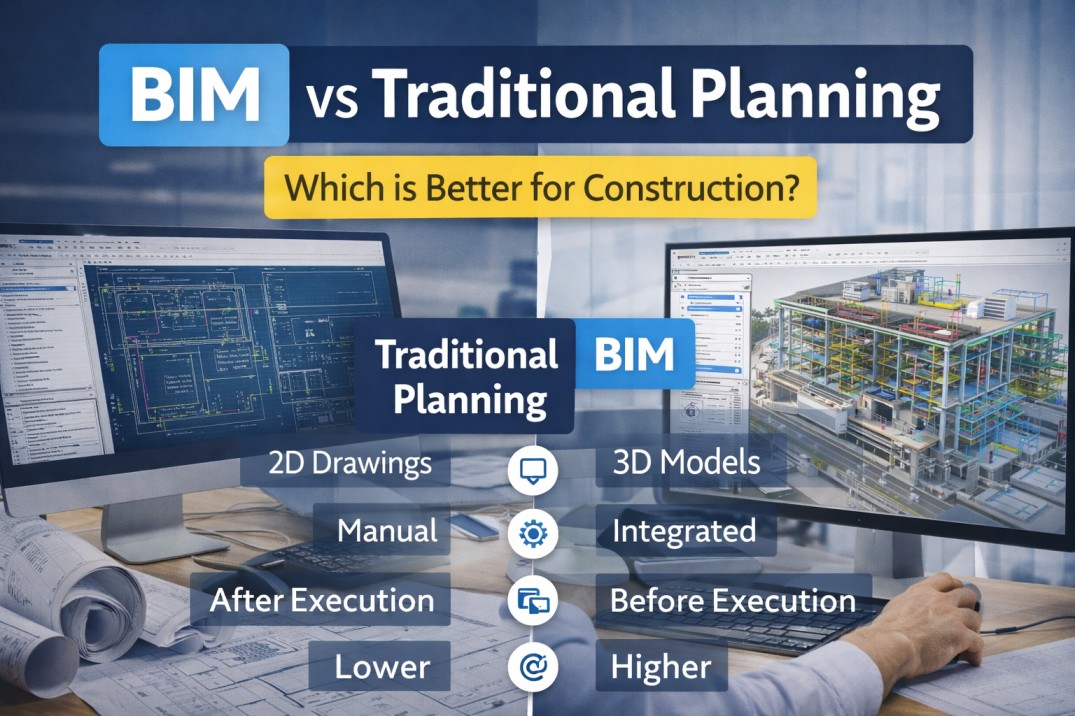
Planning plays a critical role in the success of construction and infrastructure projects. Traditionally, projects were managed using drawings, spreadsheets and manual coordination. However, with the rise of digital tools, Building Information Modeling (BIM) has transformed how projects are planned and executed.
Traditional planning relies on 2D drawings, manual schedules and isolated workflows. Coordination between disciplines such as civil, electrical and mechanical is often done manually.
BIM (Building Information Modeling) is a digital approach that integrates 3D models with time, cost and resource data. It enables real-time collaboration among stakeholders.
| Aspect | Traditional Planning | BIM Planning |
|---|---|---|
| Visualization | 2D Drawings | 3D Models |
| Coordination | Manual | Integrated |
| Error Detection | After Execution | Before Execution |
| Efficiency | Lower | Higher |
Traditional planning may still be suitable for small-scale projects where complexity and coordination requirements are limited.
While traditional planning has been the foundation of construction management, BIM offers a more advanced, efficient and collaborative approach. For large infrastructure and EPC projects, BIM is becoming a necessity rather than an option.
Gain practical experience on real infrastructure projects.
Explore Training