
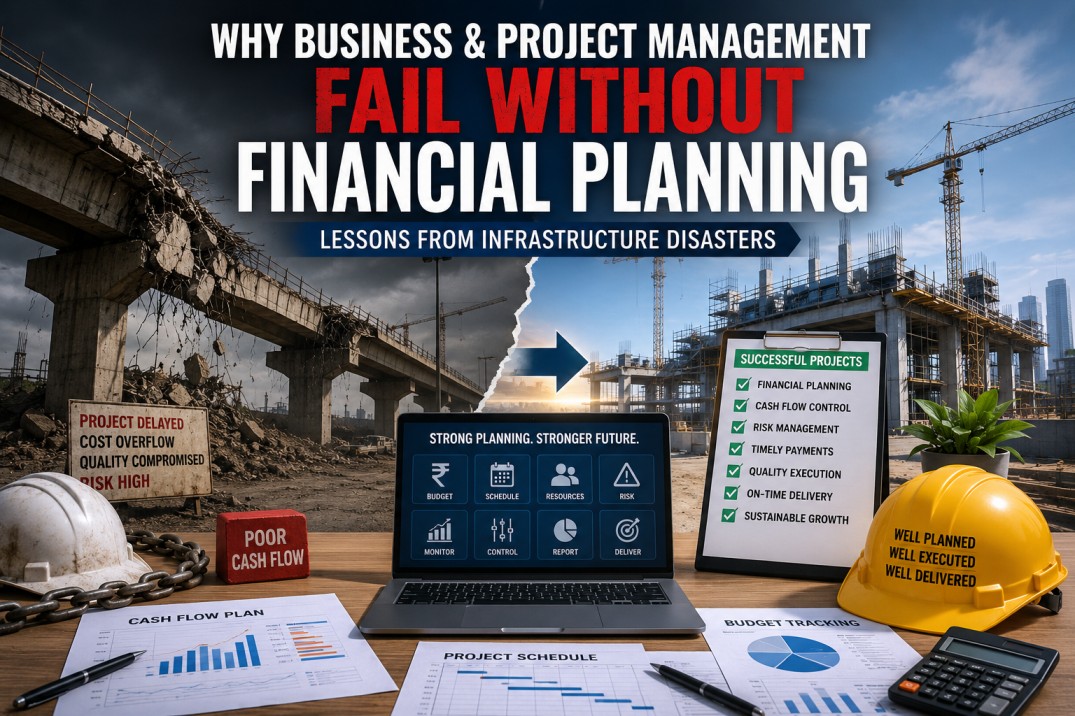
Business and Project Management are far more connected than most people realize. A project is not just about drawings, schedules, machinery or contracts — it is fundamentally about financial sustainability.
“No manpower should go unpaid on the 1st day of the month, and no supplier should wait endlessly for payment.”
This is the real foundation of professional project management.
When businesses depend entirely on supplier credit, delayed payments, unrealistic bidding or underpriced contracts, the result is not profitability — it becomes compromised quality, workforce instability, delayed schedules and eventually engineering failures.
The Biggest Mistake in Business & Project Management
Many contractors and businesses enter projects emotionally or impulsively.
- “We will manage somehow.”
- “Payments will come later.”
- “Suppliers will support us.”
- “We can recover losses through variations.”
But projects do not survive on assumptions. Projects survive on discipline.
Successful Projects Depend On:
- Cash flow planning
- Contingency reserves
- Productivity monitoring
- Financial discipline
- Resource forecasting
- Risk mitigation
- Timely payments
Why Cash Flow Planning is the Heart of Every Project
Every construction or infrastructure project consumes resources daily:
- Manpower
- Machinery
- Fuel
- Material
- Vendor services
- Logistics
- Technical supervision
Without planned cash flow, productivity drops immediately.
Effects of Poor Financial Planning
- Delayed salary payments
- Supplier payment issues
- Machinery downtime
- Compromised quality
- Schedule slippage
- Unsafe construction practices
The Danger of Unrealistic Low Bidding
One of the biggest dangers in infrastructure development is extreme underbidding. Projects awarded at unrealistic margins begin under financial stress from Day 1.
Contractors then try to recover losses through:
- Reducing manpower
- Delaying procurement
- Using low-quality materials
- Reducing supervision
- Compressing schedules unsafely
This creates a chain reaction of engineering failures.
Infrastructure Failures Are Often Management Failures
Across India, infrastructure incidents have repeatedly raised concerns about:
- Construction quality
- Weak project monitoring
- Execution pressure
- Financial stress
- Low-cost bidding strategies
Strong infrastructure is built first in planning meetings, cash flow reports and risk assessments — long before it appears on-site.
Project Management Is Not Just Scheduling
Many people assume project management only means preparing schedules in Primavera or Microsoft Project.
True project management includes:
- Financial Management
- Risk Management
- Procurement Planning
- Resource Management
- Productivity Monitoring
- Contingency Planning
The 7 M’s of Business & Project Management
- Money – Cash flow & budgeting
- Machinery – Equipment productivity
- Manpower – Workforce management
- Material – Procurement & logistics
- Methods – Systems & execution
- Management – Coordination & leadership
- Marketing – Sustainable business growth
Final Thought
A project does not fail suddenly.
Failure begins quietly:
- Delayed payments
- Poor planning
- Cash shortages
- Understaffing
- Weak monitoring
By the time cracks appear in concrete, cracks have already appeared in management systems.
Sustainable businesses are not built by winning the cheapest projects.
They are built through disciplined planning, strong financial control and responsible execution.